The D7280 dental code is an essential part of oral surgery, specifically for surgical exposure of an unerupted tooth. This procedure plays a crucial role in helping teeth that are unable to emerge naturally through the gums, often due to impaction, to eventually erupt or be positioned for orthodontic treatment. Understanding the details of this code, including its purpose, the procedure involved, and its distinction from other extraction codes, is vital for both dental professionals and patients. This article provides a comprehensive look at D7280, its uses, and its relationship with other dental codes.
Overview of D7280 Dental Code and Its Importance in Oral Surgery
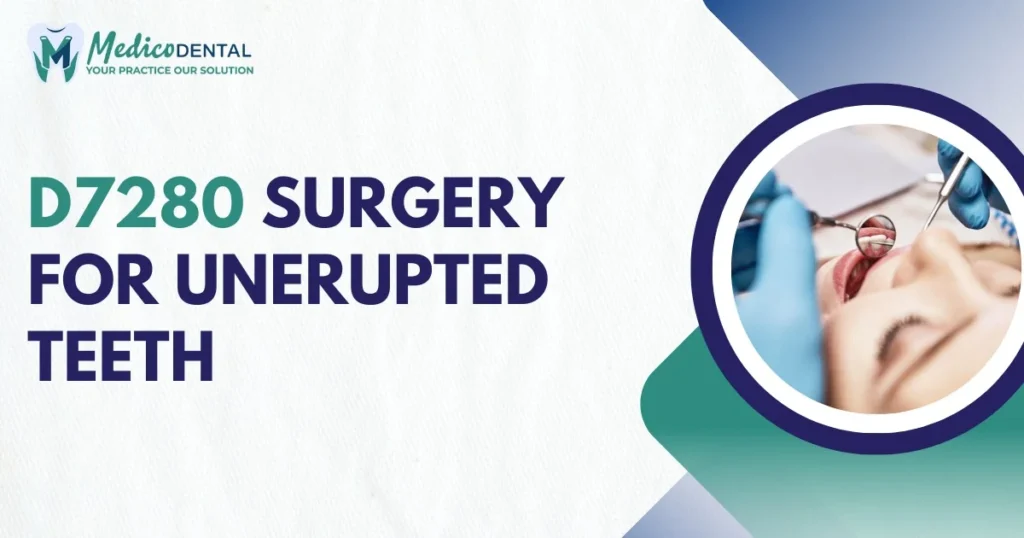
The D7280 dental code refers to the surgical exposure of an unerupted tooth that is obstructed by soft tissue or bone, typically for the purpose of aiding its eruption or preparing it for orthodontic intervention. This procedure is particularly important when a tooth, such as a canine or premolar, has not erupted into the mouth due to impaction or lack of space. D7280 allows dental professionals to access and expose the crown of the tooth for further treatment, such as attaching an orthodontic bracket or device to guide its eruption.
This surgical procedure is different from simple extractions because it doesn’t involve the removal of the tooth but rather accessing it to help facilitate its natural eruption or orthodontic movement. As impacted teeth can lead to pain, infection, or crowding of other teeth, performing the D7280 procedure helps resolve these issues.
What is the D7280 Dental Code?
Definition and Purpose of D7280
The D7280 code describes a surgical procedure to expose an unerupted tooth, which is often necessary when a tooth is unable to break through the gum line due to being blocked by soft tissue or bone. Instead of extracting the tooth, this procedure involves making an incision in the gum, reflecting the tissue, and sometimes removing small amounts of bone to access the tooth.
This procedure is typically performed in preparation for orthodontic treatment, where an orthodontist attaches a device or bracket to the exposed tooth to guide it into proper alignment. The purpose of D7280 is to provide the necessary access for further orthodontic work while avoiding the complete removal of the tooth.
Scope of the D7280 Code
The D7280 code specifically covers the exposure of a tooth that has not erupted but does not include any subsequent procedures like the placement of orthodontic devices, which would typically be coded under a different procedure. The scope of D7280 is limited to the surgical steps necessary to access the tooth so it can be treated or moved into place. This makes it an important procedure for patients who need help with tooth eruption but who are not candidates for tooth extraction.
Indications for D7280
Why is D7280 Used in Dental Procedures?
The D7280 procedure is used when a tooth is unable to emerge from the gum line due to physical obstructions, such as soft tissue or bone. The primary goal of this surgery is to expose the crown of the tooth so that it can be further treated. The procedure is commonly indicated for teeth that are:
- Impacted and unable to erupt naturally due to being blocked by surrounding tissues.
- Required for orthodontic treatment, where the exposed tooth is then moved into proper alignment.
- Cause of discomfort or crowding, where a tooth’s inability to erupt creates dental health issues.
By exposing the tooth, D7280 allows the dentist or orthodontist to place a device or bracket to help guide the tooth into the correct position.
Common Cases Where D7280 is Required
Common cases requiring D7280 include:
- Impacted Canines: Canines are commonly impacted due to insufficient space in the jaw or because of obstruction by bone or soft tissue.
- Premolars and Molars: These teeth may also become impacted, especially when there is not enough room in the dental arch for them to erupt properly.
- Delayed Eruption: Sometimes, teeth may fail to erupt within the normal time frame, requiring surgical exposure to facilitate eruption.
D7280 is often used when a tooth is deeply impacted, making it impossible for the tooth to erupt on its own or with minor dental intervention.
Procedure for D7280
Steps Involved in the Surgical Exposure of an Unerupted Tooth
The procedure typically follows a structured process:
- Anesthesia: Local anesthesia is administered to numb the affected area. In some cases, general anesthesia or sedation may be used for patient comfort.
- Incision: The surgeon makes an incision in the gum tissue over the unerupted tooth to access it. The incision is designed to be as small as possible while providing enough room to perform the exposure.
- Tissue Reflection: The gum tissue is reflected (lifted) to expose the underlying tooth. The amount of tissue removed depends on the tooth’s position and the extent of its impaction.
- Bone Removal: In some cases, a small portion of the bone covering the tooth may need to be removed to expose the crown. This step is necessary if the tooth is deeply impacted by bone.
- Exposure of the Crown: Once the tooth is fully exposed, the crown is visible, and the tooth can be further treated, such as placing an orthodontic bracket or device to guide the tooth into its proper position.
- Stitching: After the tooth is exposed, the incision site is stitched back up. The patient is provided with post operative care instructions, including pain management and oral hygiene practices.
D7280 vs. Other Extraction Codes
How D7280 Differs from Simple Extractions (e.g., D7140)
Unlike a simple extraction (D7140), where the tooth is removed entirely, D7280 focuses on exposing a tooth that has not yet erupted into the mouth. In a simple extraction, the tooth is already in the mouth, and the procedure involves removing the tooth and its root from the socket. D7280, on the other hand, is used to access and expose a tooth, often to aid in orthodontic treatment, and does not involve removing the tooth.
Comparison with Related Codes: D7282 and D7283
- D7282: This code is used for mobilizing an already erupted or malpositioned tooth. In contrast to D7280, which exposes unerupted teeth, D7282 is used to help reposition a tooth that has already emerged but is not in the correct alignment.
- D7283: This code involves the placement of an orthodontic device on an exposed tooth to help guide its eruption. While D7280 is focused on the exposure of the tooth, D7283 deals with the next step of the treatment process, aligning the tooth with an orthodontic device.
Each of these codes plays a distinct role in the treatment of impacted or misaligned teeth, with D7280 specifically addressing the exposure of unerupted teeth.
Benefits of Using the D7280 Procedure
Advantages of Surgically Exposing an Unerupted Tooth
The D7280 procedure provides several benefits, especially when treating impacted or unerupted teeth. One of the primary advantages is that it allows access to teeth that cannot emerge through the gum line on their own. For teeth that are blocked by soft tissue or bone, such as canines or premolars, D7280 ensures that they can be properly exposed and positioned for further treatment.
Some additional advantages include:
- Facilitating orthodontic treatment: Exposing an unerupted tooth makes it possible to place orthodontic brackets or devices, which helps guide the tooth into its proper alignment over time.
- Preventing complications: Without intervention, impacted teeth can cause pain, infection, or damage to neighboring teeth. D7280 helps avoid these issues by providing the necessary access for further management.
- Minimizing the need for extraction: In many cases, surgical exposure can prevent the need for extraction by helping the tooth erupt naturally or be moved into the correct position using orthodontics.
By allowing orthodontists to place devices like brackets and chains on the exposed tooth, D7280 plays a crucial role in improving overall dental health and alignment.
How D7280 Helps Facilitate Orthodontic Treatment
Once the tooth is exposed through the D7280 procedure, the next step in treatment is often orthodontic intervention. The exposed tooth is typically ready to have braces or other orthodontic appliances placed on it. This helps guide the tooth into its proper position in the dental arch.
In the case of impacted canine teeth, for example, orthodontists may use the exposed surface of the tooth to place a bracket and attach a small chain. This chain is gradually pulled, guiding the tooth into place. D7280 is the first step in this process, allowing for the necessary space and access for the orthodontic devices to work.
Potential Risks and Complications of D7280
Common Risks Associated with Surgical Exposure
Like any surgical procedure, D7280 carries some risks. While complications are rare, being aware of the potential issues is important for both patients and dental professionals.
- Infection: After any surgical procedure, there is a risk of infection at the incision site. This is especially true if post operative care instructions, such as keeping the area clean and avoiding certain foods, are not followed.
- Swelling and Bruising: Swelling around the exposed area is common after surgery and typically subsides within a few days. However, this can be uncomfortable and might require pain management.
- Damage to Surrounding Structures: There is a small risk of damaging surrounding teeth, nerves, or blood vessels during the procedure, particularly if the impacted tooth is deeply positioned.
- Dry Socket: A dry socket occurs when the blood clot that forms after surgery dislodges or dissolves too early, exposing the bone underneath. This can cause significant pain and delay healing.
- Scarring: Although rare, the incision made to expose the tooth can result in visible scarring. Proper suturing and post operative care can minimize this risk.
How to Minimize Complications
To minimize the risks associated with D7280, patients should:
- Follow post operative care instructions closely, such as keeping the surgical area clean, avoiding certain foods, and taking prescribed medications.
- Use ice packs for the first 24 hours to reduce swelling and discomfort.
- Avoid smoking or using straws, as these can increase the risk of a dry socket.
- Attend follow up appointments to monitor the healing process and address any potential complications early.
- Ensure proper hygiene around the surgical site to avoid infection.
With proper care, most complications can be avoided or treated effectively.
Billing and Insurance for D7280
Understanding Coverage for D7280 Dental Code
Many dental insurance plans cover the D7280 procedure because it is often necessary for the proper management of impacted or unerupted teeth. Insurance companies recognize that exposing a tooth is a critical step in preventing further dental issues, such as pain, infection, or damage to other teeth.
However, coverage can vary depending on the patient’s insurance plan. Some key points to consider when navigating insurance coverage for D7280 include:
- Medically necessary treatment: In many cases, exposing a tooth is considered medically necessary, especially when it is causing pain, infection, or misalignment of surrounding teeth.
- Pre authorization: Insurance providers often require pre authorization for procedures like D7280, especially if the procedure is done to aid orthodontic treatment. Dentists should provide detailed documentation to support the medical necessity.
- Orthodontic coverage: If D7280 is being done as part of an orthodontic treatment plan, some insurance companies may have separate orthodontic benefits. This means the procedure may not be fully covered under general dental plans but could be covered under orthodontic care.
Patients should always check with their insurance provider to understand what will be covered before undergoing the procedure.
How to Submit Claims and Common Billing Challenges
- Correct coding: Ensuring that the D7280 code is properly submitted is crucial for accurate dental billing. Dentists must include the appropriate diagnosis code to support the claim, indicating that the exposure was necessary due to impaction or other dental health concerns.
- Pre authorization: In many cases, dental insurers will require pre authorization before performing a D7280 procedure. This involves submitting a request to the insurance company, along with supporting documents like X rays and treatment plans, to prove the procedure’s necessity.
- Submitting claims for related procedures: If other treatments, such as orthodontic appliances or follow up procedures, are part of the treatment plan, these should be billed separately using the appropriate codes.
- Dealing with denials: If a claim is denied, patients or dental offices may need to appeal the decision, providing further documentation to demonstrate the medical necessity of the D7280 procedure.
Related Procedures and Codes
Overview of D7282 and D7283: When They Are Used
- D7282: This code is used for the mobilization of a tooth that has already erupted or is in the mouth but in a malposition. Unlike D7280, which exposes a tooth that has not erupted, D7282 is for repositioning a tooth that has erupted but is out of place.
- D7283: This code is used when an orthodontic device or appliance is placed on an exposed tooth to help guide its eruption. After D7280 exposes the tooth, D7283 helps to manage the movement of the tooth into the correct position.
These related codes work in conjunction with D7280 to address different aspects of treating impacted or misaligned teeth.
How These Codes Work in Tandem with D7280 for Orthodontic Treatment
The D7280 code is often the first step in a comprehensive treatment plan for impacted or misaligned teeth. After the tooth is exposed, codes like D7283 or D7282 are used to manage the tooth’s movement and alignment. By using these codes in tandem, dental professionals can provide a holistic treatment plan that addresses both the exposure and positioning of impacted teeth, ensuring better results for the patient.
Conclusion
The D7280 dental code plays a crucial role in the management of impacted or unerupted teeth. By surgically exposing the tooth, this procedure enables orthodontic treatment and helps resolve issues such as pain, infection, and misalignment. Understanding the benefits, risks, and billing procedures associated with D7280 is essential for both dental professionals and patients. When used appropriately, D7280 can significantly improve oral health and prevent further complications.
FAQs
What does the D7280 dental code cover?
Ans. The D7280 code covers the surgical exposure of an unerupted tooth, typically to facilitate orthodontic treatment or prevent further dental complications.
When is D7280 used?
Ans. D7280 is used when a tooth is impacted by bone or soft tissue and needs to be exposed for orthodontic treatment, such as placing braces or an orthodontic device.
How is D7280 different from a regular extraction?
Ans. Unlike a regular extraction, D7280 is used to expose a tooth, not remove it. It’s done to prepare the tooth for further treatment, like guiding it into proper alignment with orthodontic help.
What are the risks of the D7280 procedure?
Ans. The risks include infection, swelling, damage to surrounding tissues, and dry socket, though these are rare and can be minimized with proper care.
Does insurance cover D7280?
Ans. Many insurance plans cover D7280 if it’s deemed medically necessary. It’s important to check with the provider about coverage and pre authorization requirements.