Dental procedures are often identified and categorized through a standardized coding system known as Current Dental Terminology (CDT). This system, developed by the American Dental Association (ADA), enables healthcare providers to document, bill, and ensure proper reimbursement for dental services. One such procedure is the root canal repair, which is covered by the D3331 Dental Code. This specific code is used when a previously treated tooth requires a repair to address complications like infection, incomplete sealing, or fractures. Understanding the application and importance of the D3331 code is vital for both dental professionals and patients to ensure accurate treatment and billing.
Overview of Dental Codes
Dental codes serve as a universal language that helps dental professionals, insurance companies, and patients communicate about dental procedures. These codes ensure that treatment, diagnosis, and billing processes are streamlined and standardized. The CDT codes, which are updated annually, cover all aspects of dental care, from preventive measures like cleanings and exams to more complex treatments like surgeries and root canal therapies. Among these, the D3331 code stands out for its role in ensuring that root canal repairs are accurately documented and appropriately reimbursed.
Importance of D3331 in Dental Procedures
The D3331 code is crucial in situations where a patient requires additional treatment after a root canal procedure has already been performed. Despite root canal therapy being an effective treatment for infected or damaged teeth, complications can arise, such as reinfection, tooth fractures, or incomplete removal of infected tissue. The D3331 code allows dental professionals to bill for the repair of an existing root canal, ensuring the patient’s tooth is saved from further damage or extraction. Properly utilizing this code guarantees that the repair work is recognized by insurance companies, ensuring that patients receive the treatment they need without unnecessary delays or cost burdens.
What is D3331 Dental Code?
Definition and Explanation
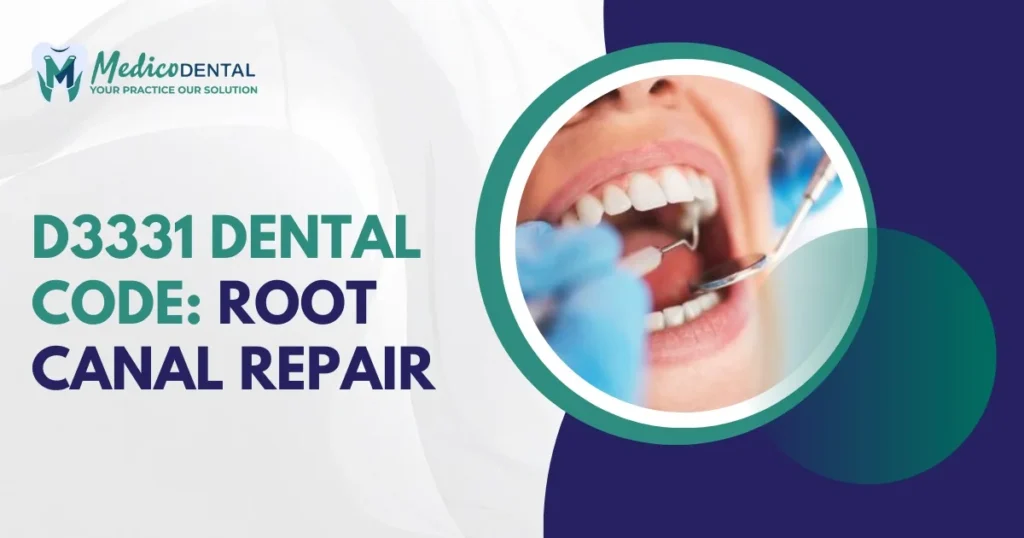
The D3331 Dental Code refers to the Root Canal Repair procedure for a previously treated tooth. This code is used when the initial root canal therapy, performed under another code (like D3330), has failed or complications arise that require repair. The procedure may involve cleaning out infected tissue, re-sealing the canal, or addressing other structural issues that have developed after the initial treatment. In many cases, this repair work is essential for saving the tooth from extraction.
Common Procedures Associated with D3331
Some of the most common procedures associated with D3331 include:
-
Retreatment of an infected root canal: The dentist cleans and reshapes the root canal to remove remaining infected tissue.
-
Sealing the root canal: The canal is refilled with an appropriate material to prevent further infection and damage.
-
Apicoectomy: In cases where infection persists, the dentist may remove the tip of the root and the surrounding infected tissue.
-
Fracture repair: If a tooth fractures during the initial treatment or afterward, a root canal repair may be necessary.
Indications for D3331: Root Canal Repair
Conditions Treated with D3331
The D3331 Dental Code is used when a previously treated root canal needs additional intervention due to complications. Some common conditions that indicate the need for a root canal repair under D3331 include:
-
Persistent infection after the initial root canal therapy.
-
Recurrent abscesses or swelling near the treated tooth.
-
Fractured or cracked teeth that affect the root canal’s integrity.
-
Incomplete root canal treatment, where the original procedure didn’t fully clean or seal the canal.
-
Leakage or failure of the filling material used in the first procedure.
When is D3331 Used in Treatment Plans?
D3331 is indicated when the dentist determines that the previous root canal procedure has not effectively resolved the issue or when complications arise that threaten the success of the tooth. Signs that may trigger the use of D3331 include:
-
Continued or recurring pain in the treated tooth.
-
Signs of reinfection visible on X-rays.
-
Tooth fractures that affect the root structure.
-
A failure in the original filling or crown, leading to new bacterial infiltration.
In treatment planning, D3331 is used when the existing root canal needs to be repaired to prevent tooth loss.
The D3331 Procedure
Step-by-Step Breakdown of the Root Canal Repair Process
The D3331 Root Canal Repair process is similar to the initial root canal treatment, though it involves additional steps to address the issues caused by complications. Here’s a typical step-by-step breakdown:
-
Initial Evaluation: The dentist reviews the patient’s medical history, takes X-rays, and assesses the current condition of the treated tooth. If complications are found, D3331 is selected.
-
Anesthesia: The dentist administers local anesthesia to numb the area around the affected tooth to ensure a pain-free experience for the patient.
-
Access Opening: The dentist removes any filling or crown from the original root canal to gain access to the inner chambers of the tooth.
-
Cleaning and Shaping: The dentist cleans out the existing root canal, removing any remaining infected tissue or bacteria. The canal is then reshaped to facilitate better sealing.
-
Disinfection: The canal is disinfected with irrigation solutions to ensure that all bacteria are eradicated.
-
Filling: The cleaned and reshaped root canal is filled with a sealing material to prevent any new infection from occurring.
-
Restoration: If necessary, the dentist will place a temporary or permanent crown or filling over the treated tooth to protect it and restore its functionality.
Tools and Techniques Involved
The tools used in D3331 Root Canal Repair are similar to those used in the initial root canal procedure, including:
-
Endodontic files to clean and shape the root canal.
-
Irrigation solutions to disinfect the canal.
-
Filling materials like gutta-percha to seal the canal.
-
X-ray machines to check the root canal’s progress and ensure proper sealing.
In cases requiring more complex procedures, like an apicoectomy, the dentist may use surgical instruments to remove the infected tissue from the root tip.
Billing and Insurance for D3331
How to Bill for D3331
Billing for D3331 requires proper documentation of the procedure and supporting evidence. Dentists must:
-
Use the correct D3331 code when submitting claims to insurance companies.
-
Include detailed descriptions of the procedure and the patient’s condition to ensure proper reimbursement.
-
Provide any supporting documentation, such as X-rays, that show the need for the root canal repair.
Insurance Coverage and Reimbursement for Root Canal Repair
Insurance coverage for D3331 varies by provider and plan. In general, most dental insurance plans will cover the D3331 procedure if it is deemed medically necessary. However, it is essential to:
-
Verify the patient’s insurance plan to check for coverage of root canal repairs.
-
Submit all required documentation for reimbursement, including diagnosis, treatment plan, and procedure details.
-
Be aware of deductibles, copayments, or coinsurance that may affect the patient’s out-of-pocket costs.
Clinical Application of D3331
Common Uses in Dental Practice
The D3331 code is applied when a previously treated root canal fails or needs additional work. Some common scenarios where D3331 is applied include:
-
Post-treatment infections that do not respond to antibiotics.
-
Root canal failure due to incomplete removal of infected tissue.
-
Fractures or cracks that affect the integrity of the treated tooth.
Case Studies and Examples
Case Study 1: A patient who underwent root canal therapy five years ago for a molar presents with pain and swelling near the treated tooth. An X-ray shows that the filling is leaking, and bacteria have infiltrated the tooth. The dentist uses D3331 to perform the root canal repair, addressing the infection and sealing the canal to prevent future issues.
Case Study 2: A patient with a cracked tooth after a previous root canal experiences continued pain and discomfort. The dentist determines that D3331 is necessary to repair the root canal, remove any infected material, and reseal the tooth.
D3331 vs Other Root Canal Codes
Comparison with Similar Dental Codes (e.g., D3330, D3348)
When discussing root canal treatments, it is important to understand how D3331 relates to other root canal codes. Here’s a breakdown:
-
D3330: This code is used for root canal treatment (non-surgical) on a molar. It is applied when a root canal is done for the first time on a tooth, typically involving cleaning and shaping the root canal to eliminate infection. D3330 is different from D3331 because D3331 refers to repairing an already-treated canal that has developed complications such as reinfection or leakage.
-
D3348: This code is used for retreatment of a root canal. It refers to a situation where the previous root canal treatment (often covered by D3330) has failed or wasn’t completed correctly. The dentist will need to clean out the old material and redo the treatment. While D3348 might seem similar to D3331, D3331 is specifically for repairs to the existing root canal, which might not always require a complete retreatment.
When to Use D3331 vs Other Root Canal Codes
D3331 should be used when there are complications with a previously performed root canal. This could be due to issues like reinfection, incomplete sealing, or tooth fractures. It is not a full retreatment like D3348 but rather an intervention to repair the existing canal.
D3330, on the other hand, should be used when the root canal is being performed for the first time on a molar or permanent tooth, typically to treat infection or damage.
-
Use D3331 when there is a failure of a previous root canal procedure but not enough damage to warrant a full retreatment.
-
Use D3348 when a previous root canal has failed completely and a more thorough procedure is needed to retreat the canal.
The key difference is that D3331 addresses repairs, while D3348 focuses on redoing the entire root canal treatment.
Challenges and Considerations
Common Issues with D3331 Coding
One of the main challenges with D3331 coding is its accurate application in the billing process. Dental offices must be sure to distinguish it from other root canal codes, such as D3330 (initial treatment) or D3348 (retreatment). Incorrect coding could result in denied claims or underpayment, as insurance providers may interpret the procedure as a standard root canal treatment rather than a repair.
Another issue that may arise is the difficulty in getting insurance approval for root canal repairs. Insurers may question whether the repair is medically necessary, especially if the patient has already received an initial root canal that failed. Clear documentation, including X-rays, patient history, and treatment justification, is essential to avoid claim denials.
How to Overcome Challenges in D3331 Procedure
To overcome the challenges associated with D3331, it is important to:
-
Properly document the reasons for the repair: Detailed documentation about the patient’s initial root canal treatment, symptoms, and clinical findings (e.g., X-rays showing leaks or reinfection) is crucial for insurance claims.
-
Ensure accurate coding: Double-check that the D3331 code is used correctly to describe a root canal repair rather than a full retreatment (D3348) or initial root canal (D3330).
-
Educate the patient: Since repairs may involve additional costs or complications, it is important to explain the procedure and its potential need for insurance coverage clearly to the patient.
-
Use pre-authorization: Before beginning the procedure, it’s often helpful to submit a pre-authorization request to insurance to ensure coverage for the root canal repair.
Post-Treatment Care After D3331
Recovery and Aftercare for Root Canal Repair
Post-treatment care after a D3331 Root Canal Repair is critical for the long-term success of the procedure. Here are the key aspects of recovery and aftercare:
-
Pain Management: Some discomfort or soreness may occur after the procedure. Over-the-counter pain relievers such as ibuprofen or acetaminophen are usually recommended, but the dentist may also prescribe stronger medications if necessary.
-
Restoration: A permanent crown is typically placed after the root canal repair to restore the tooth’s function and protect it from further damage. The patient may be given a temporary crown if immediate restoration is not possible.
-
Avoid Hard Foods: The patient should avoid chewing on hard foods or applying excessive pressure on the treated tooth until the permanent restoration is in place.
-
Follow-Up Appointments: A follow-up appointment is often scheduled to monitor the tooth’s healing and ensure there are no further issues. This is especially important to verify that the repair has successfully addressed the underlying problem.
Monitoring for Success
To ensure the success of the D3331 procedure, the patient must monitor the tooth for any signs of continued pain, swelling, or reinfection. The dentist will likely schedule follow-up appointments to assess healing, often using X-rays to confirm that the canal is properly sealed and that the infection has been cleared.
If the patient continues to experience discomfort or symptoms suggestive of reinfection, further intervention may be necessary. Monitoring is essential to avoid complications that may require retreatment under D3348.
Conclusion
The D3331 Dental Code is essential for documenting and billing root canal repairs. It is used when a previously treated tooth requires additional work to address complications like reinfection, leakage, or fractures. The key differences between D3331 and other codes, such as D3330 (initial treatment) and D3348 (retreatment), lie in the scope of the treatment. While D3331 focuses on repairs, D3330 and D3348 involve initial treatment and retreatment, respectively.
Accurate coding, proper documentation, and clear communication with insurance providers are essential to ensure that patients receive the care they need and that dental practices are appropriately reimbursed.
Understanding and using the D3331 Dental Code correctly is critical to the success of both treatment and billing. While the procedure itself can save teeth and alleviate pain, the proper coding ensures that the treatment is recognized, reimbursed, and documented appropriately. By overcoming challenges such as accurate coding and ensuring thorough aftercare, dental professionals can provide their patients with the best possible outcomes.
FAQs
What’s the difference between D3331 and D3348?
Ans. D3331 is used for root canal repairs, while D3348 is for retreatment of a root canal that has failed completely. D3348 involves more comprehensive work, whereas D3331 focuses on repairing the existing treatment.
How long does recovery take after a D3331 procedure?
Ans. Recovery time varies, but most patients can expect some discomfort for a few days. Full recovery and the placement of a permanent restoration may take a few weeks.
Can D3331 be used for multiple repairs on the same tooth?
Ans. Yes, D3331 can be used if multiple repairs are necessary, as long as the complications are related to the original root canal treatment.
Is D3331 covered by insurance?
Ans. Most insurance plans cover D3331 if the repair is deemed medically necessary. However, it’s important to check with the specific insurance provider for coverage details.
What should I do if I experience pain after a D3331 procedure?
Ans. Contact your dentist if pain persists after the procedure, as it may indicate a need for further intervention.